Telegram Stories Sequence Checklist: Hook, Context, Route
A Telegram Story has very little time to earn the next tap. That is why a channel story should not behave like a small poster. It needs a short sequence: one frame to stop the viewer, one frame to give context, and one frame to route the viewer somewhere useful.
This checklist gives channel owners a repeatable three-frame structure for Telegram Stories. Use it for a new guide, live session, collaboration reminder, poll result, product note, or short announcement that should lead to a specific link.
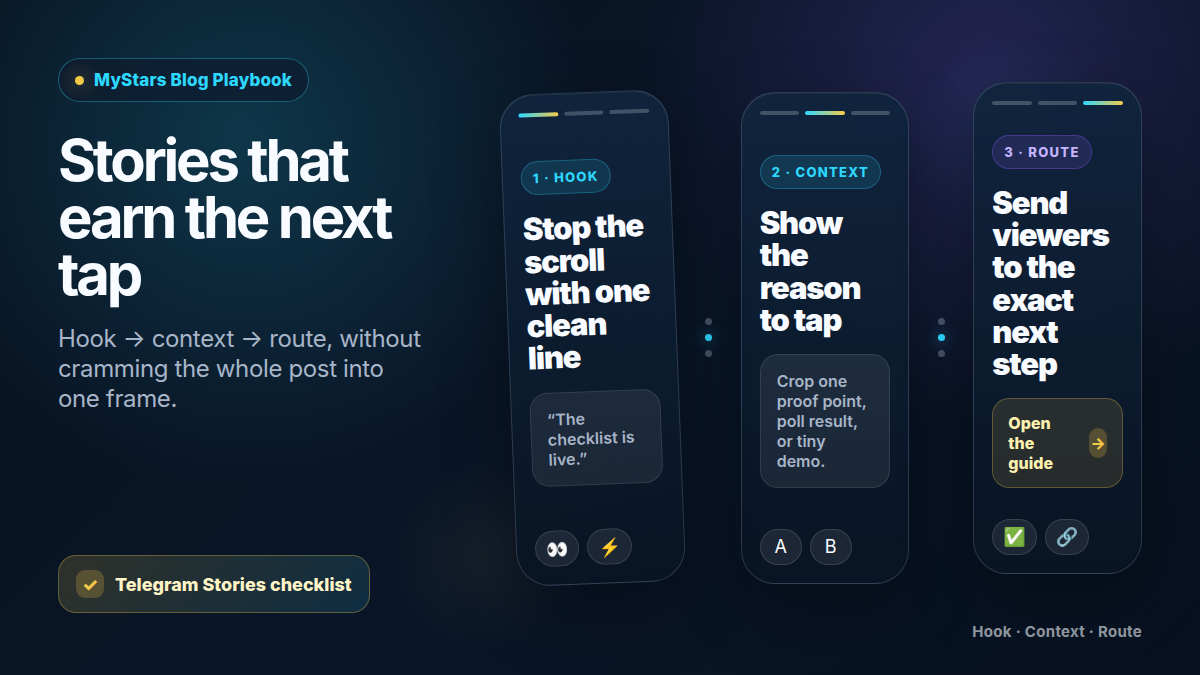
The three-frame sequence
Use this order whenever the story needs to move someone from curiosity to action.
Frame 1: Hook
The first frame should answer: "Why should I keep watching?"
Good hooks are short:
- "One mistake in tonight's setup."
- "The checklist is live."
- "Pick the next teardown."
- "3 answers before the live session."
- "New guide: read this first."
Avoid long headline stacks. If the viewer has to read for ten seconds, the frame is doing the job of a post.
Frame 2: Context
The second frame gives just enough context for the route to make sense.
Useful context can be:
- a cropped checklist item;
- a before/after example;
- a poll result;
- a short quote;
- a screenshot with one highlighted area;
- a countdown;
- a single objection answered;
- a tiny demo step.
Do not use this frame to summarize the whole article. Its job is to make the destination feel worth opening.
Frame 3: Route
The final frame should answer: "What should I do now?"
Make the route specific:
- "Open the pinned guide."
- "Read the full post."
- "Vote with the reaction sticker."
- "Join the live at 18:00 UTC."
- "Open the tool and try step 1."
- "Save this before the deadline."
A vague route like "check our channel" is weak. Send the viewer to the exact destination.
Write the caption after the frames
The caption should not repeat the image. Use it for details that are too small for the visual:
- who the story is for;
- where the full explanation lives;
- what changed since the last update;
- what time zone the deadline uses;
- what the viewer should prepare before opening the link.
A good caption is usually two short lines. It should explain the route, not compete with the frame.
Use reaction stickers only when you will act on them
Reaction stickers are not just decoration. They are a tiny research tool when the answer changes what you do next.
Use them for choices like:
- short version or full breakdown;
- beginner example or advanced teardown;
- live Q&A or written guide;
- template, checklist, or case study;
- yes, no, or "show me first".
After the story expires, close the loop. Post the result or mention it in the next story. If people vote and nothing changes, they learn not to vote again.
Connect Stories to existing channel assets
Stories work best when they point into a system you already maintain.
Use them as a light route for:
- a planned article or post from your Telegram content calendar;
- a partner announcement from your creator collaboration workflow;
- a reminder from your Telegram live stream run sheet;
- a post-campaign follow-up from your Telegram giveaway funnel checklist.
The story is the doorway. The destination should already be ready before the story sends people there.
Add a MyStars cue only at checkout distance
Most Stories do not need a checkout line. Add a MyStars cue only when the viewer is close to a checkout or balance-prep step.
Buy Telegram Stars with crypto
Need a balance ready before checkout? Top up with crypto on MyStars.
Buy Stars NowIf the story is only awareness or education, skip the checkout cue and keep the route clean.
Mobile design checks
Before publishing, preview the story on a phone-sized screen.
Check:
- main text is readable in one glance;
- the key line is not stuck under Telegram UI;
- the image is not a cluttered screenshot;
- the link or route instruction is obvious;
- each frame uses the same visual system;
- the final frame has one action, not three;
- the caption does not hide essential context.
If the story is hard to read, cut copy before shrinking the font.
Mistakes to avoid
- Turning a story into a full article screenshot.
- Using three frames that all say the same thing.
- Asking for reactions without a follow-up.
- Sending viewers to a generic channel page instead of the exact destination.
- Putting the deadline in the image but not the time zone.
- Adding a payment cue before the viewer understands why it matters.
- Letting a pretty story point to an unfinished post.
Telegram Stories checklist
Before the story goes live, confirm:
- Frame 1 gives a short hook.
- Frame 2 gives one useful context point.
- Frame 3 gives one route.
- The caption explains the route.
- Any link goes to the exact destination.
- Reaction stickers have a follow-up plan.
- Text is readable on mobile.
- A MyStars cue appears only near a checkout step.
- The destination is ready before traffic arrives.
FAQ
Should a channel story repeat the whole post?
No. A story should make the next tap feel useful. Put the full explanation in the destination.
Is one story enough?
Sometimes. But for promotion, three frames usually work better: hook, context, route. More frames are useful only when every frame has a separate job.
What should I measure?
Track the next action: replies, reactions, link taps, post views, starts, or attendance. Story views alone do not tell you whether the route worked.
When should I mention MyStars?
Mention it only when the route leads to a checkout step where the viewer may need a balance ready. If the story is just warming up a topic, wait.
Can this work for live content?
Yes. Use one frame for the topic, one for a question or proof point, and one for the time and route. Keep the full live plan separate.
Sources and evidence
- Telegram Stories launch and story features: Stories and 10 Years of Telegram.
- Telegram channel story posting, boosts, reaction stickers, and channel story counters: Stories in Channels, View-Once Media and More.
- Telegram Live Stories context for channels and groups that unlocked Stories via boosts: Live Stories, Repeated Messages, Auctions for Gifts and More.
- MyStars top-up path for readers who need a balance ready: MyStars.