Telegram Giveaway Funnel Checklist: Grow Without Empty Subscribers
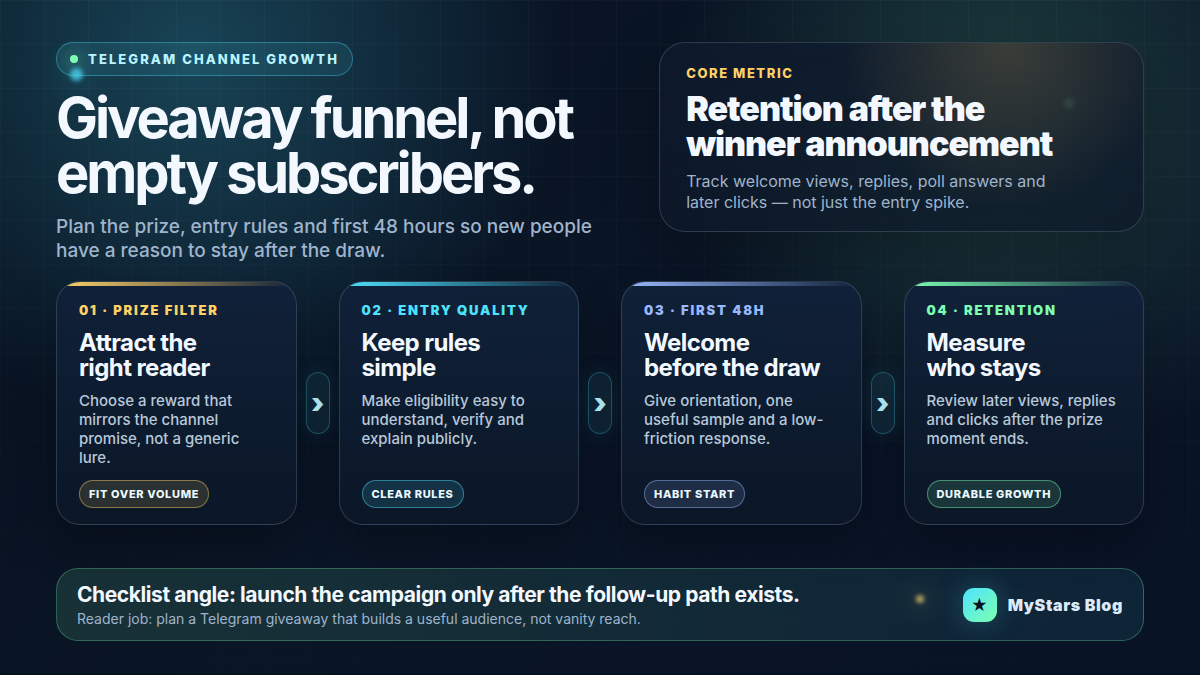
A Telegram giveaway can create a quick subscriber spike. The useful question is what remains one week after the winner is announced.
This checklist is for channel owners who want a giveaway to attract relevant people, explain the channel promise, and keep new readers engaged after the prize draw. It is not a shortcut for empty reach.
Telegram’s native giveaway feature lets channel owners distribute prizes among followers, define eligibility rules, and have Telegram select winners based on those rules. That solves the mechanics. It does not solve positioning, entry quality, welcome flow, or retention.
Define the job of the giveaway
Write one sentence before you choose a prize:
“This giveaway should bring in people who care about ___ and will want to keep reading because ___.”
Strong examples:
- “...people who care about freelance design systems and will keep reading for templates and critiques.”
- “...people who care about beginner crypto habits and will keep reading for wallet safety lessons.”
- “...people who care about short home workouts and will keep reading for a seven-day plan.”
Weak examples:
- “...people who like free things.”
- “...anyone who joins fast.”
- “...traffic for the next big push.”
A giveaway is a campaign, not a finish line. If the channel does not already have a reliable publishing rhythm, connect this plan to the content calendar playbook first.
Prerequisites
Prepare these pieces before the announcement:
- Target reader — who should enter, and who is outside the fit.
- Prize filter — why the prize attracts the same person the channel serves.
- Entry rules — subscriber status, timing, geography, and any extra channel requirements.
- Welcome message — a short explanation of what the channel helps with and where to start.
- Proof message — one useful sample that shows the value without asking for anything.
- Segmentation signal — a poll, reply prompt, or simple choice that tells you why people joined.
- Review window — the exact day you will compare entry volume, views, replies, and retention.
Step-by-step giveaway funnel
1. Pick a prize that filters the audience
A broad prize brings broad traffic. A useful prize brings relevant people.
Use this rule:
- If almost anyone wants the prize, expect lower retention.
- If only your target reader wants the prize, expect fewer entries and better quality.
- If the prize teaches people what the channel is about, the follow-up becomes easier.
Examples:
- A design channel can give away a template audit or a prompt pack.
- A language channel can give away a speaking feedback session.
- A crypto education channel can give away a beginner wallet checklist review.
- A fitness channel can give away a short program review.
The prize should feel like a sample of the channel, not an unrelated lure.
2. Write the promise before the rules
Most giveaway announcements start with mechanics. Better campaigns start with fit.
Use this structure:
- Who this is for. Name the person who should enter.
- Why the prize is useful. Tie it to the channel topic.
- What new readers get next. Explain the first useful thing they should read or do.
- How the draw works. Keep eligibility and timing easy to verify.
If the rules take more space than the promise, simplify them. Confusing rules create support noise and weak trust.
3. Build the first 48 hours after entry
New subscribers decide quickly whether the channel belongs in their daily feed.
Prepare three messages:
- Orientation. “Start here” message with one best resource.
- Useful sample. A checklist, teardown, mini-lesson, or answer to a frequent question.
- Low-friction response. A poll or reply prompt that helps you learn why they joined.
Do not wait until after the winner announcement to provide value. The prize brings attention; the first 48 hours decide whether attention becomes a habit.
4. Add one segmentation question
Ask one simple question during the campaign:
- “What are you trying to improve this month?”
- “Which level are you at: beginner, active, advanced?”
- “Which resource would help most next?”
- “What made you join: prize, topic, partner, or recommendation?”
Use the answer to adapt the next message. If the new group is mostly beginners, avoid advanced jargon. If they joined for a specific resource, continue that thread instead of switching topics.
For deeper audience handling, use the audience work playbook after the campaign so the new group does not stay anonymous.
5. Coordinate partner traffic carefully
If another channel promotes the giveaway, give that partner a clear short brief:
- who the campaign is for;
- what the prize actually solves;
- what the reader should expect after joining;
- what not to promise;
- which message or link should be forwarded.
Partner traffic can be strong, but only if the partner’s audience fits. If you plan a joint campaign, reuse the partner-fit checks from the creator collaborations guide.
6. Review retention, not only entries
Subscriber count is the easiest number to see and the easiest number to misread.
Compare these signals:
- announcement views;
- welcome-message views;
- reply or poll rate;
- forwards from partners;
- views after the winner announcement;
- unfollows or visible drop-off;
- clicks to the next resource;
- number of people who continue interacting after the campaign.
If you already run weekly reporting, add the giveaway to your channel analytics review. A campaign that creates entries but weakens later views needs a narrower prize or a better welcome path.
Decision branches
If entries are high but later views are weak
The prize was probably too broad. Tighten the next prize around the reader’s real job, not general excitement.
If entries are low but replies are strong
You may have a small but qualified campaign. Keep the audience and improve distribution before changing the prize.
If the same question appears repeatedly
The rules were unclear. Pin a short FAQ and remove any requirement that needs private explanation.
If partner traffic does not retain
Review partner fit. A larger partner is not always a better partner.
If the campaign creates attention but no next step
Your first 48 hours were too thin. Add orientation, useful sample, and one response prompt before repeating the campaign.
Mistakes to avoid
- Choosing a prize unrelated to the channel promise.
- Letting mechanics hide the reason to stay.
- Posting the winner announcement and then going quiet.
- Asking too many segmentation questions.
- Changing topics immediately after the draw.
- Treating every new subscriber as equally qualified.
- Measuring only the spike and ignoring retention.
Troubleshooting checklist
- Many entries, weak later views — likely cause: the prize attracted casual traffic. Fix: choose a narrower prize and improve the welcome message.
- Few entries, strong replies — likely cause: distribution is weak but fit may be good. Fix: repeat with a better partner or clearer announcement.
- Rules questions fill the comments — likely cause: eligibility is too complicated. Fix: simplify rules and pin a short FAQ.
- New readers do not respond — likely cause: no easy first action. Fix: add one poll or one reply prompt.
- The channel goes quiet after the draw — likely cause: no retention path. Fix: schedule the first three follow-up messages before launch.
FAQ
Should a Telegram giveaway always use a big prize?
No. A relevant prize usually matters more than a large prize. The goal is to attract people who will keep reading after the draw.
How many follow-up messages should I prepare?
Prepare at least three: orientation, useful sample, and one low-friction response prompt. More is fine if the campaign is large, but those three are the minimum.
Should I ask people to join several channels?
Only if every requirement is easy to understand and the partner channels are relevant. Too many requirements can reduce trust and increase support questions.
What should I measure after the winner is announced?
Measure welcome-message views, reply or poll rate, later views, drop-off, and clicks to the next resource. Subscriber count alone does not show whether the campaign worked.
Sources and evidence
- Telegram, “Giveaways in Channels and Free Premium” — native channel giveaways, follower prizes, eligibility rules, and Telegram-selected winners: https://telegram.org/blog/giveaways
Buy Telegram Stars with crypto
Prepare Stars before a bot, mini app, or paid media flow — top up with MyStars.
Buy Stars Now