Telegram Sponsor Intake Checklist: Qualify Deals Before You Post
A sponsor request is not a deal yet. It is an input.
Before you quote a price or draft a Telegram channel post, run the request through an intake checklist. The checklist protects three things: audience trust, your time, and the sponsor's chance of getting a useful result.
The best intake process is simple. It helps you decide one of four outcomes:
- accept the request;
- ask for a cleaner brief;
- offer a small test;
- decline before the channel takes the risk.
Who this is for
Use this playbook if you run a Telegram channel, creator community, niche audience, or bot-related audience and outside partners ask for placement.
It is useful when requests arrive as vague messages like:
- “Can you promote us?”
- “How much for a post?”
- “We have a launch tomorrow.”
- “Just share this link.”
Do not answer those with a price first. Answer with intake.
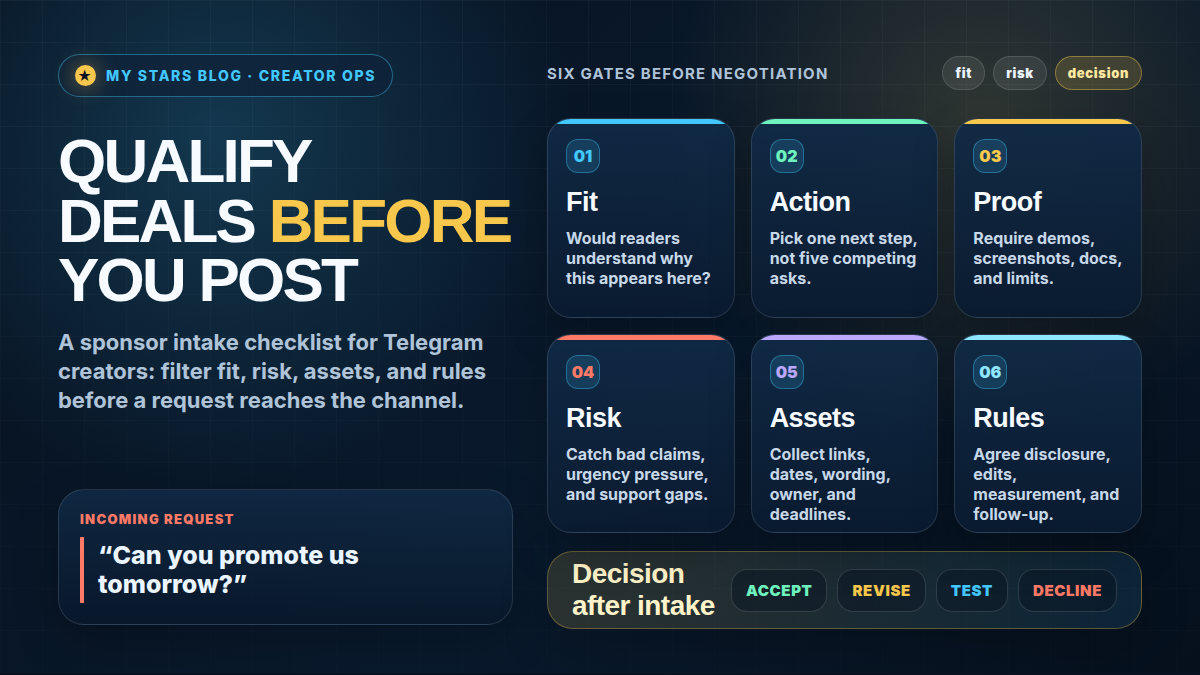
The six-question intake screen
Ask these questions before negotiation:
- Fit: why would this make sense for this audience?
- Reader action: what should a reader do after seeing it?
- Proof: what evidence, demo, screenshot, or explanation supports the claim?
- Risk: what could confuse, disappoint, or harm readers?
- Assets: what does the partner need to send before drafting?
- Rules: what will be disclosed, edited, measured, and supported?
If the partner cannot answer the basics, pause the deal. A weak brief usually becomes a weak placement.
Intake step 1: audience fit
Write one sentence:
This request is a fit because it helps [reader segment] do [specific job].
Good examples:
- “It helps small Telegram shop owners compare checkout options.”
- “It helps bot builders reduce confusion before the first paid action.”
- “It helps creators test whether their audience wants a deeper paid resource.”
Weak examples:
- “Everyone might like it.”
- “They pay well.”
- “It is crypto, so it fits.”
A sponsor should be able to pass the channel promise test. If your regular readers would ask “why is this here?”, the request needs a better angle or a no.
Intake step 2: reader action
A sponsor request is not clear until the reader action is clear.
Choose one action:
- open a landing page;
- start a bot;
- join a waitlist;
- read a comparison;
- answer a short question;
- save a checklist;
- try a demo;
- prepare for a time-limited purchase.
One post should not ask for five actions. If the partner wants awareness, clicks, comments, sales, feedback, and support in the same placement, split the campaign or reduce the goal.
Intake step 3: proof and claims
Ask the partner for proof before you draft.
Useful proof can be:
- a product page that explains the offer clearly;
- a demo account or screen recording;
- screenshots you are allowed to use;
- public documentation;
- customer examples with permission;
- limitations, exclusions, or known restrictions;
- a support contact for follow-up questions.
Do not publish claims that you cannot defend. If a partner uses guaranteed-result language, rewrite it or decline.
For your own proof, keep normal channel evidence ready: view ranges, forwards, replies, poll results, and reader questions. The Telegram Channel Analytics Playbook helps you decide which signals are worth showing.
Intake step 4: risk screen
Some requests are risky even when they look profitable.
Red flags:
- unclear product owner;
- confusing landing page;
- unrealistic deadline;
- pressure to hide disclosure;
- income, investment, health, legal, or guaranteed-outcome claims;
- no support owner after readers click;
- product language that sounds unlike your channel;
- request to imply personal use when you have not tested it.
Use a simple rule: the higher the risk, the stronger the proof must be. If the proof is weak, decline.
Intake step 5: asset pack
Before a draft starts, collect:
- sponsor name and contact;
- plain-language offer summary;
- target link or entry point;
- desired reader action;
- campaign dates and time zone;
- screenshots, demo, or public docs;
- claims allowed and claims to avoid;
- disclosure wording;
- edit deadline;
- support contact;
- payment or buyer-readiness note, if a purchase follows.
This asset pack prevents the common mess: the post is drafted, then the partner changes the offer, adds risky claims, or sends missing details too late.
Intake step 6: placement decision
After intake, choose one outcome.
Accept
Use this when the fit is strong, proof is clear, risk is low, and the assets are complete enough to draft.
Revise
Use this when the sponsor fits the audience but the brief is vague. Ask for clearer proof, a simpler reader action, or safer wording.
Test
Use this when the sponsor is promising but unproven. Offer a smaller placement, one question, or one limited campaign window.
Decline
Use this when the request does not fit the channel, creates too much risk, or needs claims you cannot verify.
If the request is really a partner swap or cross-promotion, move it into a collab workflow instead. The Telegram Creator Collabs Playbook is better for that path.
Copy this intake checklist
Save this as your sponsor request template:
- Partner name:
- Contact person:
- Product or campaign:
- Best-fit reader segment:
- Reader problem solved:
- Desired reader action:
- Target link or entry point:
- Proof supplied:
- Claims allowed:
- Claims to avoid:
- Campaign dates:
- Disclosure wording:
- Draft owner:
- Edit deadline:
- Support owner:
- Buyer-readiness note, if relevant:
- Decision: accept / revise / test / decline:
You can send a shorter version to the partner, but keep the full version for yourself.
Where Stars and MyStars fit
Do not force a Stars mention into every sponsor request.
Use it only when the campaign leads to a real Telegram-native paid step where the reader may need a Stars balance ready before the deadline. In that case, make the purchase path clear early instead of surprising the reader at the end.
For broader creator monetization context, use How to Monetize Telegram Content with Stars as the supporting guide.
Buy Telegram Stars with crypto
If readers need Stars ready for a paid Telegram action, top up on MyStars before the campaign deadline.
Buy Stars NowMistakes to avoid
- Quoting a price before checking fit.
- Publishing from a vague brief.
- Letting the sponsor write in a voice your audience does not trust.
- Accepting claims you cannot verify.
- Hiding disclosure rules until the last draft.
- Asking readers to take too many actions.
- Forgetting who will answer support questions after the placement.
FAQ
Should a small Telegram channel accept sponsors?
Only when the fit is strong. A small, trusted audience can be valuable, but a poor match can damage trust quickly.
What should I ask before giving a price?
Ask for the audience fit, reader action, proof, risk level, asset pack, disclosure needs, timing, and support owner. Price after you understand the work.
What if the sponsor wants guaranteed sales?
Do not guarantee sales. You can agree on placement, timing, format, and reporting. The result depends on the offer, trust, landing page, and follow-up.
Should every sponsor post include a MyStars CTA?
No. Add a MyStars CTA only when the reader action involves a Stars-paid step or buyer balance readiness. Otherwise keep the post focused on the sponsor's specific action.
Sources and evidence
- Telegram Channels FAQ: Telegram describes channels as a tool for broadcasting public messages to large audiences, with unlimited subscribers and approximate view counters. https://telegram.org/faq_channels
- Telegram Stars announcement: Telegram introduced Stars for digital goods and services in bots and mini apps. https://telegram.org/blog/telegram-stars
- Telegram Bot Payments API for Digital Goods and Services: bot transactions for digital goods and services use Telegram Stars with the
XTRcurrency tag. https://core.telegram.org/bots/payments-stars