Telegram Channel Analytics: Views, Forwards, and Buyer Signals
Most channel owners read Telegram analytics backward. They open the post with the biggest view count, call it a winner, and then wonder why the next offer lands flat.
Views matter, but they are only the first signal. If you want people to subscribe, reply, click, join a waitlist, buy a template, try a bot, or pay with Telegram Stars later, you need a sharper question: which posts make readers move?
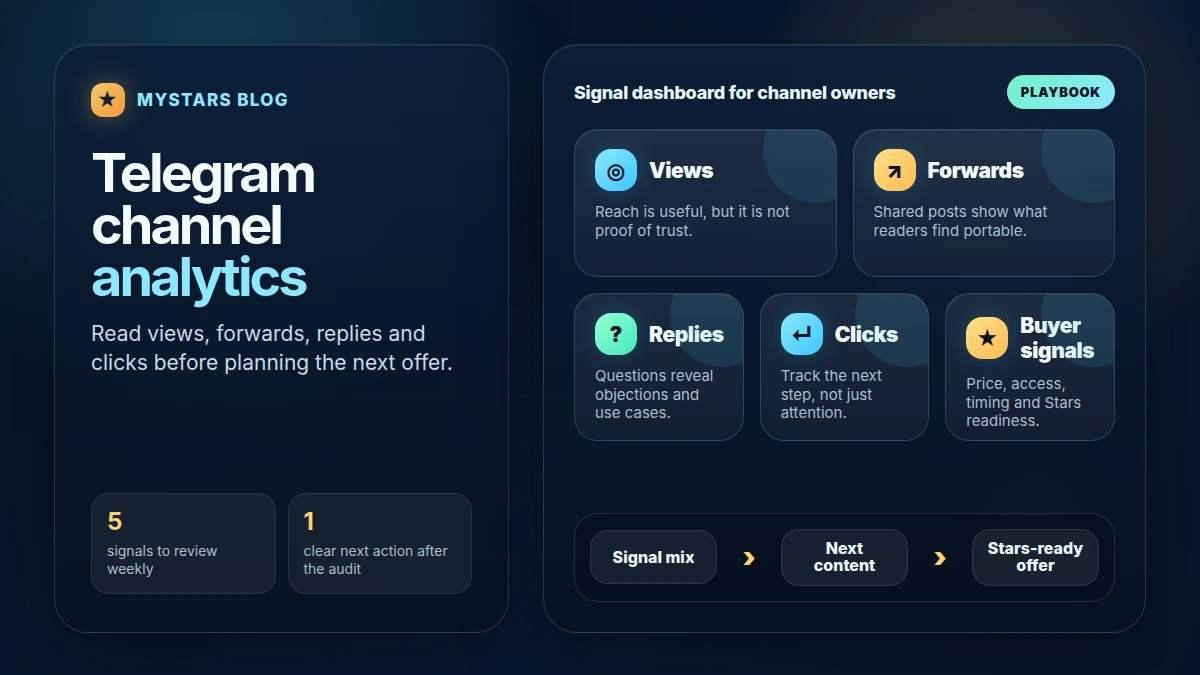
Use this playbook to review views, forwards, replies, trackable clicks, and buyer intent before planning your next content or offer.
What Telegram numbers can tell you
Telegram gives channel owners a useful starting point, but the numbers need context.
Telegram's Channels FAQ says each channel post has a view counter, and views from forwarded copies are included in the total. The same FAQ also says view counts are approximate because Telegram does not keep a permanent record of every view.
Telegram's Channels feature page adds two more useful details: channel posts can show view counters, and channels with more than 500 subscribers can access detailed statistics about growth and post performance.
So treat analytics as a directional map, not a cash register.
A view can mean someone saw the post in your channel, saw a forwarded copy, opened the channel later, or returned after Telegram had already forgotten the earlier view. A forward can mean the post was useful enough to share. A reply can mean curiosity, confusion, trust, pushback, or buying intent.
That is why you should read signals in groups.
Start with one weekly question
Do not open analytics with a vague goal like "grow the channel." Pick one question for the week.
Good questions:
- Which topic brings qualified readers back?
- Which format gets forwarded by the right audience?
- Which post creates replies from potential buyers?
- Which CTA gets people to read the offer page or pinned starter post?
- Which posts should become a template, bot feature, consultation, community offer, or launch test?
A small channel can answer these questions without a complex dashboard. You need a spreadsheet, five to ten recent posts, and honest notes.
Build a five-signal review
Review each post through five signals. Do not use them as a rigid score. Use them as prompts.
1. Views: did the post reach people?
Views show reach. They do not prove trust.
Useful checks:
- Compare posts from the same week, not random posts from different months.
- Separate format from topic: a short checklist and a long story should not be judged only by raw views.
- Mark whether the post was forwarded by another channel, mentioned in a discussion, or boosted by a launch.
If one post has high views but no replies, forwards, or clicks, it may be broad curiosity. That can help awareness. It may not be the best base for a commercial offer.
2. Forwards: did people want to share it?
Forwards are stronger than views because a reader put the post in front of someone else.
Look for posts that teach something portable:
- a checklist;
- a teardown;
- a mistake-and-fix post;
- a pricing example;
- a small template;
- a clear before-and-after.
Forwarded posts are good candidates for partner reposts, collaborations, and audience growth. If your content keeps getting forwarded but new subscribers do not stay, fix the channel bio, pinned post, and starter content before chasing more traffic.
Use the Telegram Audience Work Playbook after a forward-heavy week. It covers segmentation, feedback, and retention once new readers arrive.
3. Replies and comments: what did people ask?
Replies and comments are messy, but they show what readers care enough to type.
Telegram's Channels FAQ says channel owners can add a discussion group so subscribers see a comment button for posts. If your channel uses comments, review the actual words people use.
Sort replies into four buckets:
- confusion: they did not understand the topic or next step;
- objection: they see a risk, price issue, region issue, or trust gap;
- use case: they tell you how they would use the idea;
- buyer signal: they ask about price, timing, access, delivery, or support.
Do not ignore objections. They often show what your next post should explain before you ask for money.
4. Clicks and reply prompts: did people take the next step?
Telegram does not magically explain every off-channel action. If you want to track clicks, use a clean link setup: UTM tags, a short link you control, a dedicated landing page, or a clear reply prompt.
Examples:
- "Reply with CHECKLIST if you want the template."
- "Open the pinned starter guide before Friday's launch."
- "Use this link only from today's post."
- "Send READY if you want the offer reminder."
Keep it simple. If your tracking setup takes longer than the campaign, it is too much.
5. Buyer signals: did the post move someone closer to paying?
A buyer signal is not only a purchase. It can happen earlier.
Look for:
- questions about price;
- requests for examples;
- replies asking whether the offer fits their case;
- clicks to a pricing or checkout page;
- people asking how access, delivery, or support works;
- readers asking how many Stars they need for a Telegram-native purchase.
This is where MyStars becomes relevant. If the next action requires Telegram Stars, readers should not discover the payment step at the last second. Give them a simple preparation path before the launch window.
For broader monetization planning, connect the analytics review with How to Monetize Telegram Content with Stars. If readers are new to the payment layer, send them to What Are Telegram Stars and Why You Need Them in 2026. If the main issue is audience quality rather than payment, go back to the Telegram Audience Work Playbook.
Buy Telegram Stars with crypto
Planning a Stars-powered offer? Help readers prepare their Stars balance with MyStars.
Buy Stars NowA simple weekly analytics workflow
Use this once a week.
- Choose 5 to 10 posts from the same period.
- Add the basic fields: date, topic, format, CTA, views, forwards, replies, and tracked clicks if you have them.
- Add one sentence about context: partner repost, launch week, quiet week, news spike, or normal posting.
- Mark the strongest signal for each post: reach, share, discussion, click, or buyer intent.
- Choose one action for next week.
The final step matters most. Analytics without an action becomes trivia.
Possible actions:
- repeat the winning format with a narrower topic;
- turn a forwarded post into a partner collaboration asset;
- answer the strongest objection in a new post;
- improve the pinned starter post;
- move a proven topic into a template, bot action, consultation, or community offer;
- delay the offer because the audience is still confused.
Decision guide: what the signal mix usually means
High views, low forwards, low replies
The post reached people, but it did not give them a reason to act.
Try a sharper promise, shorter opening, clearer example, or a practical takeaway readers can save or forward.
Low views, high replies
The topic may be narrow but valuable. Read the replies carefully. If they come from the right audience, this can become a paid offer, support article, or workshop topic.
High forwards, weak subscriber growth
The asset is useful, but your channel landing surface is not doing enough. Fix the bio, pinned post, recent content, and first CTA.
Good clicks, weak purchases
People cared enough to move, then something slowed them down. Check the landing page, price, proof, payment timing, and whether the next step is explained clearly.
Many objections before launch
Do not force the launch. Turn the objections into content first: proof, use cases, FAQ, pricing logic, or payment preparation.
What to measure before a paid offer
Before you ask the audience to pay, check four things.
First, does the audience understand the outcome? If they cannot repeat what they get, they will not pay.
Second, did any free post create a buyer signal? Replies, clicks, quote requests, and "how much?" questions are more useful than raw views.
Third, is the payment path clear? Readers should know whether they need Telegram Stars, a bot flow, a form, or a direct conversation.
Fourth, is the follow-up ready? After someone pays or shows interest, they need the next post, bot message, delivery note, or support path.
If one of these is missing, fix it before asking for money.
Mistakes to avoid
Do not crown the biggest view count as the best post. It may be broad, not valuable.
Do not compare unrelated posts. A launch announcement, a tutorial, and a personal note have different jobs.
Do not pretend approximate view counts are exact attribution. Use them as a signal, not proof.
Do not add a hard sell under every strong post. Sometimes the best next step is a reply prompt or a useful pinned guide.
Do not hide payment preparation until the last minute. If a reader needs Stars, give them time to prepare.
Troubleshooting
The channel gets views but no replies
Ask for one specific response. A vague "what do you think?" usually gets ignored. Try "reply with the one step that blocks your launch" or "send PRICE if you want the pricing template."
People forward posts but do not subscribe
The post is stronger than the channel landing surface. Rewrite the bio, pin a starter guide, and make the latest three posts match the promise that brought people in.
Replies are active but nobody buys
You may have attention, not urgency. Look for objections in the replies. Price, trust, timing, unclear outcome, and payment friction are common blockers.
Clicks are good but checkout is weak
Check whether the page explains the offer, price, delivery, and payment path. If the next step uses Telegram Stars, remind readers early and point them to a preparation route.
The team argues about what worked
Write a one-line hypothesis before the post goes live. Example: "This checklist should get forwards from channel owners who need a pricing template." After publishing, review the result against that hypothesis.
FAQ
What is a good view count for a Telegram channel post?
There is no universal number. Compare the post to your own recent posts, then check whether it also created forwards, replies, clicks, or buyer signals.
Are Telegram channel view counts exact?
No. Telegram says channel post views are approximate, and forwarded-copy views can be included in the total. Use view count as direction, not exact attribution.
How often should a channel owner review analytics?
Weekly is enough for most channels. Daily review can make you chase noise unless you are running a launch or paid campaign.
What is the best signal before launching a paid offer?
Buyer-intent replies and tracked clicks are usually stronger than views. If people ask about price, access, examples, delivery, or payment, you have a better reason to test an offer.
Can Telegram analytics tell me whether readers have enough Stars?
Not directly. You need to watch for payment-readiness questions and give readers a clear preparation path before a Stars-powered action.
Should I optimize for forwards or sales?
Use forwards for reach and trust building. Use replies, clicks, and buyer questions to decide whether an offer is ready.
Where should MyStars fit in the funnel?
MyStars fits near the payment-readiness step. Once the audience understands the offer and needs Telegram Stars to act, point readers to MyStars before the launch window.
Final checklist
Before planning next week's content or offer:
- Pick one analytics question.
- Review similar posts from the same period.
- Separate views from forwards, replies, clicks, and buyer signals.
- Read comments for objections and use cases.
- Choose one next action, not ten.
- Fix the channel landing surface if forwards do not become subscribers.
- Explain Stars readiness before any Stars-powered action.
A good analytics review should leave you with a decision. If the decision is not clear, the next post should test one sharper question, not another random idea.