How to Price Paid Telegram Media with Stars
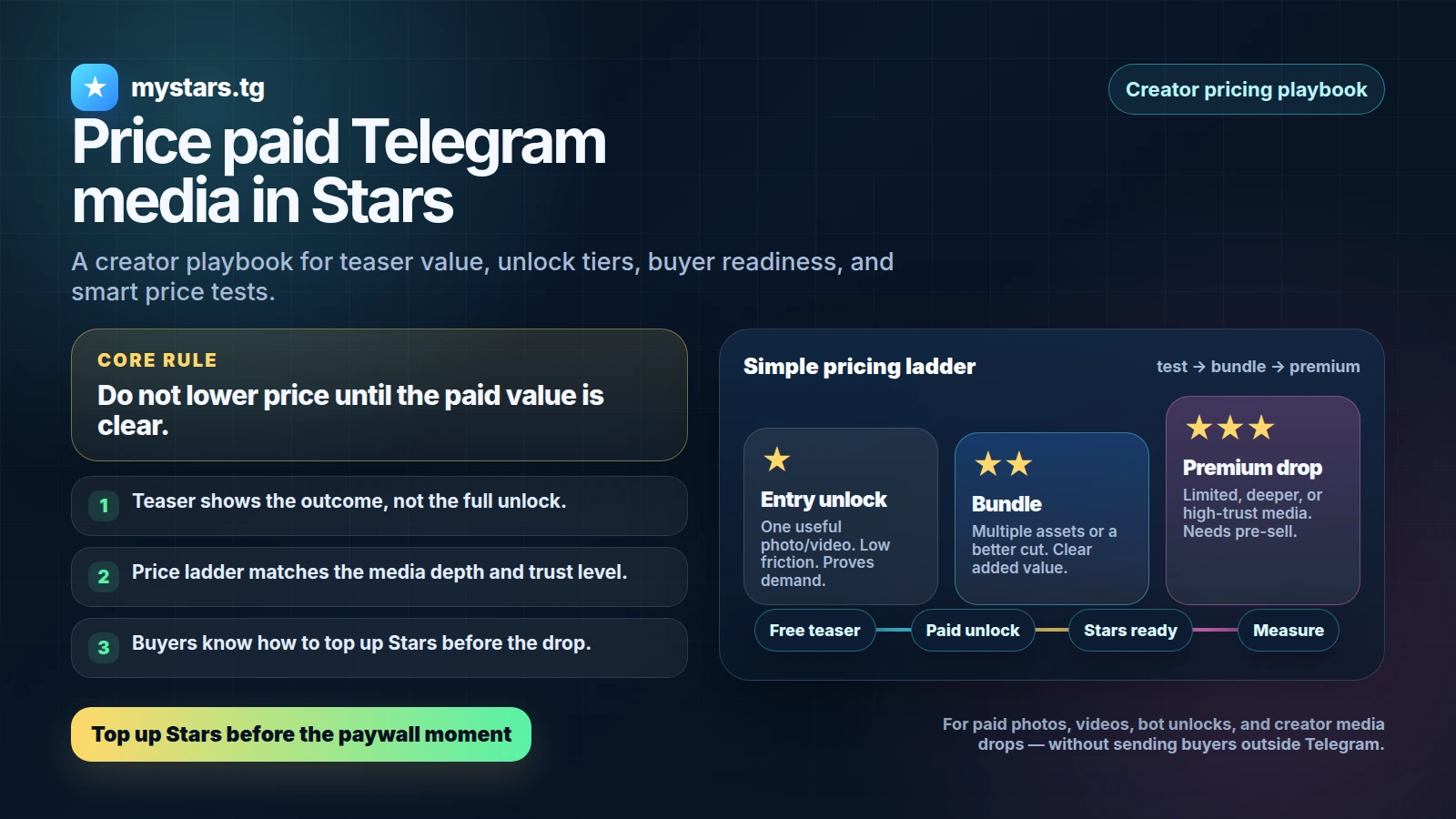
If your first paid media drop does not sell, the price may not be the real problem.
Sometimes the paid value is vague. Sometimes the free teaser gives away too much. Sometimes buyers want to unlock but do not have enough Telegram Stars ready. Price matters, but it only works when the offer is clear.
This playbook is for creators pricing paid Telegram photos, videos, and other supported paid media with Stars. If your audience is still new to the balance itself, start with what Telegram Stars can do for creator monetization. If you already know the offer and need a launch schedule, use the paid Telegram media launch plan after this pricing step.
What you are actually pricing
You are not pricing a file. You are pricing a decision:
- “Do I understand what I unlock?”
- “Do I trust this creator enough to pay now?”
- “Do I already have enough Stars, or is topping up too much friction?”
- “Is this paid item meaningfully better than the free teaser?”
That is why two creators can sell similar media at different prices. The difference is not only audience size. It is trust, timing, teaser clarity, and how ready the buyer is when the paywall appears.
Keep the paid-media scope clear
Telegram Stars can support several creator/business flows, but they should not be mixed together in one pricing rule.
Native paid media is about paid photos, videos, and supported media unlocks. Bots can also sell digital goods or services with Stars, and subscriptions can gate broader access. Those are related monetization paths, but they are not the same pricing problem.
For this article, the main case is a paid media drop: a creator posts a free teaser, then asks the audience to spend Stars to unlock the media.
The simple pricing ladder
Use a ladder before you use exact numbers. The exact Star amount depends on your audience, niche, trust level, and previous paid behavior, but the structure should be simple.
1. Entry unlock
Use this for a first paid test or a single useful piece of media.
Good for:
- one photo or short video;
- a first paid experiment;
- a new audience that has not paid you before;
- proof that people understand the offer.
The goal is not to maximize revenue on the first drop. The goal is to learn whether people will unlock when the value is clear.
2. Bundle
Use this when you can honestly offer more than one asset or a stronger version of the same promise.
Good for:
- multiple photos/videos;
- a before/after set;
- a tutorial pack;
- several cuts from the same shoot or event;
- a higher-signal content pack.
A bundle should not be “the same thing, just more expensive.” It needs visible added value before the buyer pays.
3. Premium drop
Use this only when there is already trust or a reason to believe the audience will pay more.
Good for:
- limited or time-sensitive media;
- high-effort production;
- a recurring buyer audience;
- content that solves a specific high-value problem;
- a creator with strong demand and proof from earlier unlocks.
Premium pricing fails when it looks like a random price jump. It works when the buyer can explain why this unlock is different.
Price photos, videos, bundles, and access separately
A common mistake is using one price for every paid format.
A single photo, a short video, a multi-asset bundle, a private bot action, and subscription-style access do not create the same buyer expectation. If you price them the same, one of two things usually happens: the simple unlock feels expensive, or the premium unlock feels underpriced.
A better model:
- single media unlock: low-friction test;
- stronger video or set: higher value, stronger teaser required;
- bundle: clear package benefit;
- premium/limited drop: only after trust is proven;
- bot or digital service: price around the action/result, not just the file;
- subscription access: price around frequency and ongoing value.
This keeps your audience from feeling that Stars prices are arbitrary.
Build the teaser before you set the price
The teaser has one job: make the paid value specific without giving away the whole unlock.
Weak teaser:
New video inside. Unlock if you want.
Better teaser:
I cut the full 4-minute walkthrough into a paid video: setup, mistake, result, and the exact settings I used.
The second version tells the buyer what the paid media contains. It does not reveal the full value, but it makes the purchase easier to understand.
For paid media, a useful teaser usually includes:
- the topic or outcome;
- what is inside the unlock;
- who it is for;
- why it is not fully shown for free;
- a clear Stars top-up reminder before launch.
Give buyers a Stars path before the paywall
A buyer can want the media and still fail to unlock it if they do not have Stars ready.
That is why creator pricing should include buyer readiness. Before a paid drop goes live, post a short reminder:
Paid media drop later today. If you want to unlock it instantly, make sure your Stars balance is ready first.
Then link to a simple top-up path. On MyStars, readers can buy Telegram Stars with crypto and prepare their balance before the paid media appears. If they use TON, point them to the TON buying guide. If they prefer USDT, remind them that MyStars accepts USDT on TON only.
How to test the first three drops
Do not test five things at once. Keep the format simple.
Drop 1: prove the unlock
Use a lower-friction entry unlock and a very clear teaser.
Measure:
- did people understand what was paid;
- did anyone unlock;
- did buyers complain about value;
- did non-buyers ask what was inside;
- did people have enough Stars ready.
Drop 2: test a bundle
If the first paid item was understood, try a bundle with visibly more value.
Measure:
- unlock rate compared with drop 1;
- comments or replies about price;
- repeat buyers;
- whether the teaser made the bundle feel different.
Drop 3: test premium only if there is proof
Do not jump to premium because one person bought. Use premium when there is a reason:
- repeat buyers exist;
- people asked for more;
- the bundle performed well;
- the content is clearly harder to produce or more useful.
If premium fails, that does not always mean the price is too high. It may mean the trust level was not ready.
Decision tree: what to change after a weak drop
If nobody unlocks
Check the teaser first. Was the paid value specific? Did the audience know what was inside? Did you remind them to prepare Stars?
Do not cut the price immediately. Rewrite the offer and try another clear entry unlock.
If people ask what is inside
The teaser is too vague. Add more detail about the format, result, or asset count.
If people like the teaser but do not buy
The value may be clear, but the price or balance friction may be too high. Try a lower-friction entry unlock or post a Stars top-up reminder earlier.
If people buy once but not again
The first unlock may have overpromised. Improve the paid value before raising price.
If buyers are happy and repeat
Test bundles or premium drops slowly. Keep one stable entry option so new buyers can still start.
Mistakes to avoid
Giving away the whole value for free
If the teaser already contains the best part, the paid media becomes a tip jar, not an unlock.
Making the paid value too mysterious
Mystery can create curiosity, but vague paid offers create hesitation. Buyers need enough detail to trust the unlock.
Pricing every media drop the same
Different formats deserve different expectations. A single photo, a video, a bundle, and limited access should not all use the same logic.
Calling text-only posts “paid media”
Keep the wording precise. Native paid media is about supported media formats such as photos and videos. For text, bot actions, digital goods, or ongoing access, use the correct flow and pricing model.
Launching before buyers can top up
If your audience has to stop, find a top-up route, buy Stars, return, and then unlock, you lose momentum. Warm up the top-up path before the drop.
The pricing checklist
Before you publish paid media, answer these questions:
- What exactly does the buyer unlock?
- Is the teaser specific without giving away the full value?
- Is this an entry unlock, a bundle, or a premium drop?
- Why is this price fair for this audience right now?
- Have buyers been reminded to prepare Stars?
- Is there a clear top-up path if their balance is low?
- What one metric will you learn from this drop?
If you cannot answer those questions, fix the offer before changing the price.
Sources and evidence
Telegram's official product updates describe paid photos and videos in channels and paid media for bots and Business accounts. See Telegram's update on Star Reactions, Subscriptions, and paid media.
Telegram's developer docs explain Stars payments for digital goods and services through the Bot Payments API. See Bot Payments API for Digital Goods and Services.
Telegram's Bot API also documents the sendPaidMedia method for paid media. See sendPaidMedia.
Bottom line
A good Stars price is not only a number. It is a clear paid promise, a teaser that creates trust, and a buyer who can top up before the paywall moment.
Start with an entry unlock. Learn what people understand. Then move into bundles and premium drops only when the paid value is proven.