Telegram Invite Link Source Map: Track Growth Campaigns
Most Telegram growth campaigns fail at the same boring step: nobody can tell where the useful subscribers came from.
A creator posts one public link everywhere. A partner shares it. A QR code goes on a slide. A bot link appears in a comment. A day later the subscriber count is up, but the team has no idea which source brought people who read, replied, clicked, or returned.
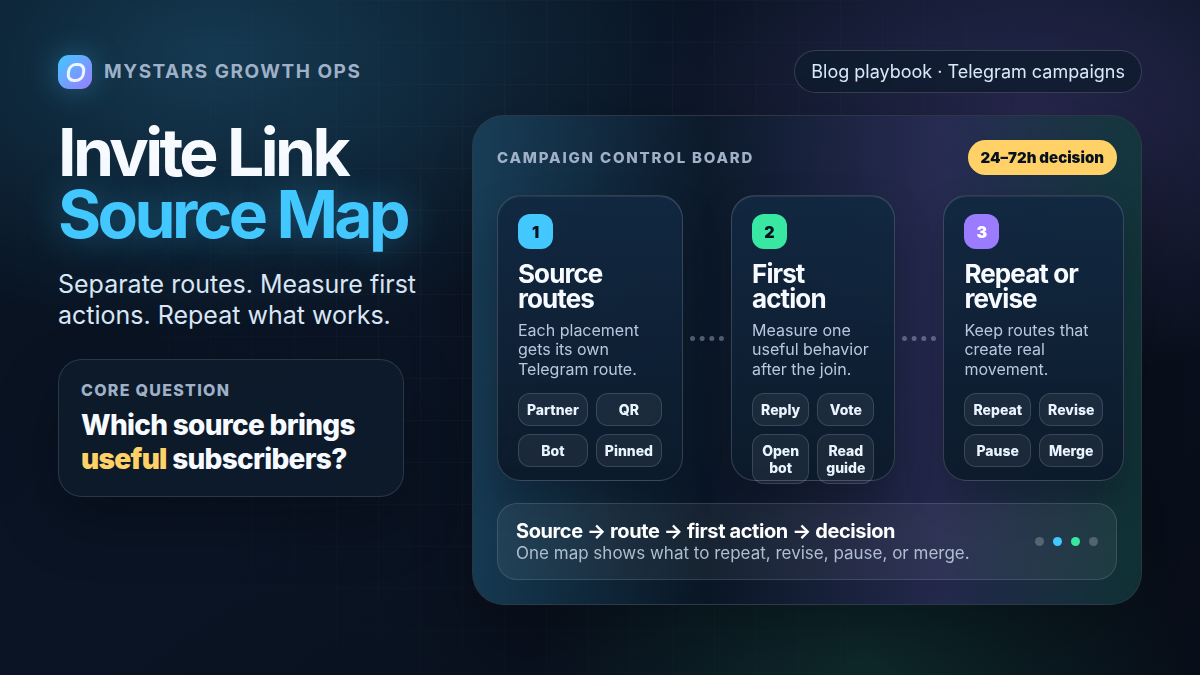
A source map fixes that. It is a small operating sheet that connects each campaign placement to its own Telegram route, first-screen promise, and follow-up metric.
Use this playbook before a channel promotion, partner swap, event, QR placement, bot demo, or creator campaign.
1. Start with the source question
Before making links, write the one question you want the campaign to answer.
Examples:
- Which partner brings subscribers who open the pinned guide?
- Which QR placement gets people to join after the event?
- Which post format sends people to the bot demo?
- Which comment-thread mention creates useful replies, not just joins?
- Which audience segment returns after the first day?
If you cannot name the question, you will create too many links and learn nothing.
A simple source map should have five columns:
- source name;
- Telegram route;
- first-screen promise;
- first action to measure;
- decision after 24–72 hours.
Keep it small. Three to seven sources are enough for a first test.
2. Give each source its own Telegram route
Do not use the same link for every placement if source quality matters.
Use separate routes:
- one invite link for each partner;
- one invite link for the pinned channel post;
- one QR route for offline or live-session traffic;
- one bot deep link for a bot-first campaign;
- one public
t.melink only when source tracking is not important.
Telegram’s invite-links update says channel and group admins can create additional links with a limited duration, a limited number of uses, or both. It also says admins can see which users joined through each invite link. That is exactly what a source map needs: separate routes for separate placements.
For public discovery, Telegram’s FAQ describes how usernames create t.me links for users, groups, and channels. Use that stable public link for evergreen visibility. Use campaign-specific invite links when you need to compare sources.
3. Name links like a human will read them later
A source map breaks when link names are vague.
Avoid names like:
- link 1;
- promo;
- june test;
- partner;
- QR.
Use names that explain the source and date:
partner_anna_jul01;pinned_start_here_jul01;event_slide_qr_jul01;comments_teardown_jul01;bot_demo_start_jul01.
The name should answer: where did this person come from, and what promise did they see?
If you later copy the same route into a spreadsheet, a CRM note, or an analytics dashboard, keep the same naming. Do not invent a second naming system.
4. Match the first screen to the source
A tracked link is not enough. New subscribers need to land on a screen that matches why they clicked.
If the source says “get the checklist,” the first visible message should point to the checklist.
If the source says “watch the bot demo,” the bot’s first response should open the demo path.
If the source says “join before the live session,” the pinned message should show the session time and what to do next.
Mismatch creates silent subscribers. They join, look around, and leave because the channel does not confirm the promise.
For campaigns that need a full publishing rhythm around the source map, use the Telegram content calendar as the planning layer. The source map is the measurement layer, not a replacement for the content plan.
5. Use bot deep links when the first action is inside a bot
If the route starts in a bot, a normal channel invite link is not enough.
Telegram’s Bot API supports deep links with a start parameter. When a user opens a bot from a link like https://t.me/your_bot?start=event_jul01, the bot receives that value in the /start command. Telegram’s docs also note that the parameter can be up to 64 characters and should use allowed URL-safe characters.
Use this when you need the bot to know the source:
- partner demo;
- event attendee;
- channel pinned route;
- QR route;
- support intake route;
- early-access route.
Keep the bot response aligned with the source. Do not send every referred user to the same generic menu.
6. Use QR routes only when the scan promise is obvious
QR codes are useful when people see your Telegram route away from Telegram: a slide, flyer, merch insert, livestream overlay, booth screen, or printed handout.
Do not make the QR code the whole campaign. Write the scan promise next to it:
- “Scan for the event checklist.”
- “Scan to get the bot demo route.”
- “Scan for tomorrow’s channel teardown.”
- “Scan to join the private test group.”
Telegram’s invite-link update says any invite link can be converted into a scannable QR code. That makes QR a practical source in the same map as partner posts and channel placements.
Decision rule: if the person would not understand why to scan without your verbal explanation, the QR promise is too weak.
7. Measure the first action, not just the join
A source map should not reward empty joins.
Pick one first action for each campaign:
- read the pinned guide;
- reply to a prompt;
- vote in a poll;
- open the bot demo;
- click the resource link;
- join the live session;
- save or forward the key post.
For larger channels and groups, Telegram has statistics for activity and growth. Campaign-level source links add the missing layer: which route created the behavior you wanted?
Use the Telegram channel analytics guide when you need to decide whether views, forwards, replies, or clicks are the strongest signal for the next campaign.
8. Add a quality note for every source
After 24–72 hours, write one sentence next to each source.
Examples:
- “High joins, low first action: promise was too broad.”
- “Low joins, high replies: keep the source, improve the hook.”
- “QR scans worked only when the slide showed the checklist promise.”
- “Bot route worked, but the first screen needs a shorter menu.”
- “Partner sent the right audience; repeat with a clearer pinned message.”
This one-sentence note prevents the team from repeating a source just because it looked busy.
If the campaign is tied to a giveaway, compare it with the Telegram giveaway funnel checklist so the prize route does not hide weak retention.
If one source brings a different reader segment than expected, use the audience work playbook to route those people without flattening every subscriber into the same promise.
9. Keep the MyStars route near the real checkout step
Do not put a Stars top-up message into every growth link. That makes the invite feel like an ad.
Add the MyStars route only when the campaign later leads to a real purchase moment, such as a creator access offer, bot unlock, or paid digital item. In the source map, mark that as a later step:
- source route: where the subscriber came from;
- first action: what they did first;
- checkout route: where the paid step happens;
- readiness note: whether the user needs Telegram Stars before that step.
That keeps the growth message clean while still making the payment path easy when it matters.
Buy Telegram Stars with crypto
When your campaign has a real Stars checkout step, prepare the route with MyStars before traffic arrives.
Buy Stars Now10. Use this source-map template
Copy this structure into a note, spreadsheet, or project board:
- Source: partner / QR / pinned post / bot / comment / live session.
- Route: invite link, public
t.melink, QR code, or bot deep link. - Promise: what the user expects after clicking.
- First screen: pinned post, bot message, channel post, or group intro.
- First action: reply, vote, open bot, read guide, click resource, join session.
- Quality note: what happened after 24–72 hours.
- Decision: repeat, revise, pause, or merge into another source.
Here is a small example:
- Source: partner creator post.
- Route: partner-specific invite link.
- Promise: “join for the Telegram campaign teardown.”
- First screen: pinned teardown message.
- First action: reply with one campaign mistake.
- Quality note: low joins, high replies.
- Decision: repeat with a stronger hook.
Mistakes to avoid
- Using one link for every source.
- Naming links so vaguely that nobody can read the report later.
- Tracking joins but ignoring first actions.
- Sending QR traffic to a channel with no matching pinned message.
- Using bot deep links but showing a generic
/startmenu. - Treating prize traffic as high quality before checking retention.
- Putting the checkout message before the user understands the offer.
FAQ
What is a Telegram invite link source map?
It is a simple table that connects each campaign source to a specific Telegram route, promise, first action, and follow-up decision.
Do I need separate links for every post?
No. Use separate links only for sources you plan to compare. Three to seven routes are usually enough for a clean test.
Should I use a public t.me link or an invite link?
Use a public t.me link for evergreen discovery. Use separate invite links when you need source-level comparison for a campaign.
When should I use a bot deep link?
Use it when the first meaningful action happens inside the bot or when the bot needs to know where the user came from.
Can QR codes be part of the same map?
Yes. Treat each QR placement as its own source and write the scan promise beside it. Do not rely on the QR code alone to explain the value.
Where does MyStars fit?
Only near the real purchase step. If a campaign later leads to a Stars-based checkout, make the MyStars route easy to find there. Keep the first growth link focused on the promise and first action.
Sources and evidence
- Telegram FAQ on usernames and public
t.melinks: https://telegram.org/faq#q-what-are-usernames-how-do-i-get-one - Telegram invite links update: https://telegram.org/blog/autodelete-inv2
- Telegram Bot API deep linking: https://core.telegram.org/bots/features#deep-linking
- Telegram channel/group statistics update: https://telegram.org/blog/profile-videos-people-nearby-and-more#channel-statistics
- Telegram Stars payments for digital goods and services: https://core.telegram.org/bots/payments-stars